
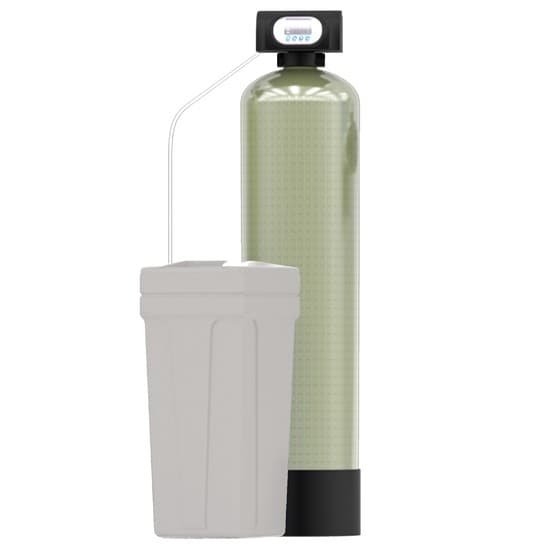
Multifunctional filter AquaLong Multi 4
€1,069
It is used to eliminate calcium and magnesium (total water hardness) up to 5 mmol/l, remove the sum of iron and manganese values up to 10 mg/l, COD Mn: max. 10 mg/l
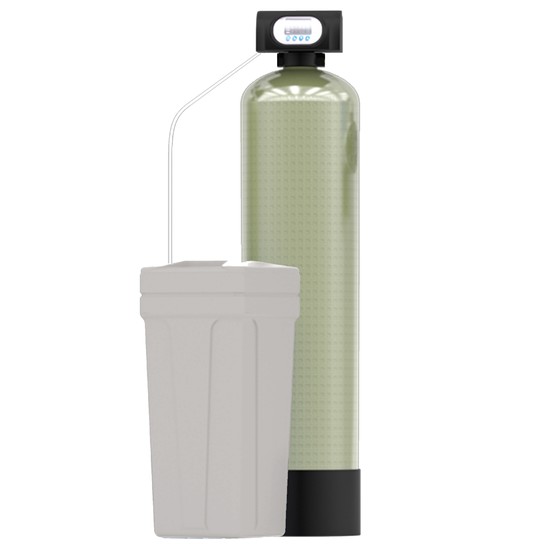
The AquaLong Multi 4 multifunctional filter is used to eliminate calcium and magnesium (total water hardness) up to 5 mmol/l, remove the sum of iron and manganese values up to 10mg/l, COD Mn: max. 10 mg/l.
Use
This multifunctional filter is used to remove the so-called hardness of water, iron and manganese in apartments, family houses, in small, medium and large enterprises.
By removing calcium and magnesium:
- remove limescale from water kettles,
- remove water hardness,
- remove white deposits on the tap, sink, etc.,
- extend the life of your washing machine, dishwasher or boiler,
- you will save on detergents and detergents (dishes and clothes are best washed and washed in soft water),
- You will save on electricity (soft water heats up faster).
How to choose the right multifunctional filter
Multifunctional filters are distinguished by the flow rate (and volume of the filter media). To find out what type of multifilter you need, you need to make the following calculation:
- Count the maximum number of people who can turn on the water at the same time. Here you must take into account all taps, showers, bathrooms and toilets and people who live with you or can visit you. The flow rate from 1 tap is 7 l/min or 7 x 60 min = 420 l/h or 0.42 m3/h.
- Multiply the number of taps (people) by the flow rate of one tap.
- Choose a filter whose flow rate is higher than the value you obtain.
For example:
- Let's say your family consists of 4 people, plus guests can come, and the maximum number of taps open at the same time is 6.
- Multiply the number of taps (people) by the flow rate of one tap: 6 x 0.42 = 2.52 m3/h.
- The flow rate of your filter should therefore be higher than 2.52 m3/h.
Design and principle of operation
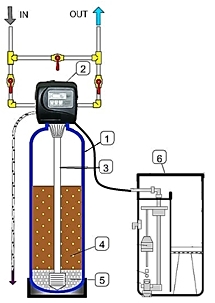
- Filter housing (filter column). The filter housing is made seamless from food-grade glass fibre. This ensures maximum strength and corrosion resistance. The bushing is a hollow cylinder with a spherical top and bottom. The case is fixed to the base. In the upper part, there is a neck for filling and unloading fillers (gravel and ion exchange resin). The socket has an internal thread for mounting a control valve.
- Runxin control valve with regeneration according to the volume of flowing water, which is adjusted once when installing the filter.
- Drainage and distribution system. It consists of a vertical tube and other elements that prevent the filter media from washing out of the housing during filter operation. The control valve with the upper cap attached is screwed into the housing, which slides it onto the tube.
- The filter media EKOTAR A filter material represents a mixture of cationic ion exchange pitches of various granulometric compositions, macroporous anion ion exchange pitches and inert pitches. It is designed to remove dissolved iron, complex ferrous organic compounds, manganese and salts causing water hardness. Comprehensive removal of all impurities (wells, shallow boreholes). Visual evaluation of the source water: yellow-brown colour, sediment forms after standing.
- Base layer of gravel on which the filter media is laid. The total volume of the filling is about 2/3 of the volume of the case. The free space above the media is necessary in terms of the expansion of the filter media during backwashing.
- Salt tank. For the preparation and storage of regenerative saline solution.
Method of eliminating water hardness using multifilters
The method is based on the use of ion exchange resin.
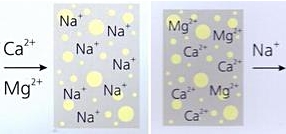
Ion exchange resin (filling) absorbs negatively charged hardness salt ions (calcium and magnesium) in contact with water. Instead, it provides sodium ions. This method is called sodium cation.
The advantage of the ion exchange method is that it does not require the supply of external energy and is cheap.
After some time, however, the ion exchange resin becomes saturated with calcium and magnesium ions and its sodium supply is depleted. Replacing the resin is a relatively expensive affair and therefore repeated regeneration is applied during the long life of the filling. The regeneration process is flushing with a solution of table salt. Calcium and magnesium ions are released from the resin into the water (which are flushed into the sewer), and resin takes sodium ions from the salt solution. The process of softening and regeneration is reciprocal.
Input water requirements
| Total hardness: | max. 5 mmol/l |
| Iron: | max. 8 mg/l |
| Manganese: | max. 2 mg/l |
| COD Mn: | max. 10 mg/l |
Technical information
| Pressure tank: | 12" x 52" |
| Maximum water flow, m3/h: | 1,85 |
| Quartz sand (3-5 mm), liter: | 13 |
| ECOTAR A ion-exchange resin, litre: | 51 |
| PE salt container, liter: | 100 |
| Salt consumption per regeneration, kg: | 6,11 |
| Control unit: | Runxin F116Q3 |
| Connection: | 1" |
| Amount of water needed for one regeneration, m3: | 0,37 |
How to find out the dimensions of the filter:
Look at the dimensions of the tank (1" = 2.54 cm) and add 12 cm to the control unit.
Salt container dimensions (height x width): 100 l = 89 cm x 38 cm
The AquaLong Multi multifunctional filter differs only in dimensions. The principle of operation is the same.